



Winemaking at Malhadinha Nova
The Scientist’s Lab
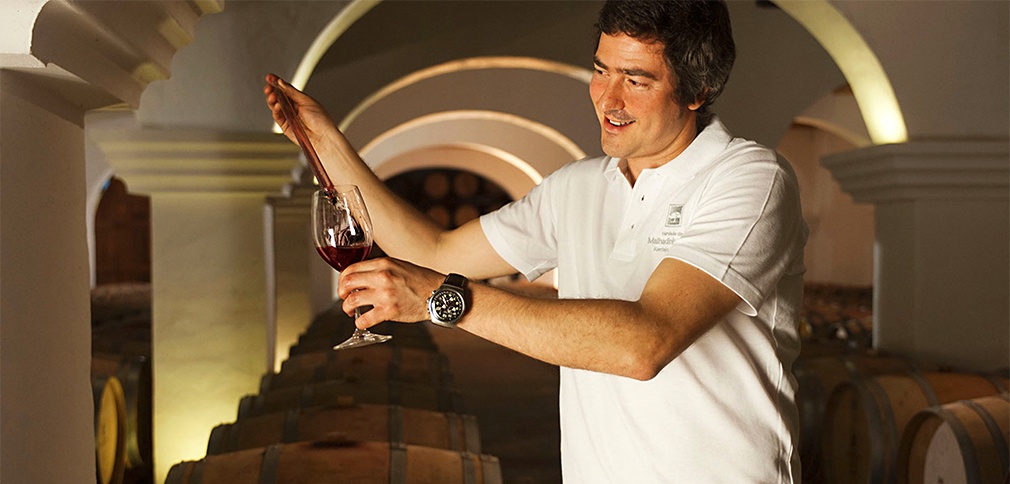
Nuño Gonzalez, resident winemaker at Malhadinha Nova, was trained as a biochemist. Today he uses his scientific grounding to help his colleagues select and blend the best grapes in the best combinations to produce award-winning wines year on year.

‘The winery at Malhadinha is a combination of state of the art equipment and traditional methods’
NUÑO GONZALEZ has been the resident winemaker at Malhadinha Nova since January 2012. Together with consultant winemaker Luis Duarte; Elisa Costa, who is in charge of the lab; cellarmaster Luis Bravo; and the Soares family (João, Rita and Paulo), he forms a key part of the wine team responsible for bringing some of the best new Alentejan wines on to the Portuguese – and international – market. In its first few years, the winery won numerous awards, including three trophies at the IWC 2005 in London: the James Rodgers Trophy, the Alentejo Trophy and the Portuguese Red Trophy. Those awards set the bar pretty high and drew a lot of attention to a new producer in a part of the Alentejo that didn’t have a history or tradition in terms of wine production.
Gonzalez’s interest in wine began at a fairly young age. His father was a surgeon who kept a good cellar and Nuño began tasting wine at the age of 16. His degree is in biochemistry, with a specialisation in viticulture and enology. ‘I was in my last year,’ he explains, ‘and everyone was looking for internships in laboratories, pharmaceutical companies and research projects, covering lots of different areas. I had already had the idea of studying winemaking after finishing. I was very fortunate to find a group at my university that was working on the effects of red wine consumption and its benefits. After a short interview, we agreed that I would do a harvest at a winery and collect some samples. My thesis was on the trials and analytical techniques used.’ Asked if he sees the rest of his degree as relevant to his career, Gonzalez doesn’t hesitate: ‘Yes, definitely. Biochemistry is the basis of everything that lives and surrounds us. Wine is a living organism too. This course gave me the foundations to understand the winemaking process from the grape to the bottle.’
Since graduating, Gonzalez has worked in many different countries around the globe. One particular experience that sticks in his mind is working in Australia. ‘I was working in a top winery with very talented and professional young people with a great positive view on winemaking. I don’t think that there are many wineries where the senior winemaker digs out a tank with an intern after a vintage party at 8am. The party had finished at 5am…’
Within Portugal, Gonzalez says he learnt most during his time at Niepoort. ‘We received grapes from different terroirs inside the Douro, and it was an eye opening experience tasting the grapes from various sites. Minimal intervention, it’s a cliché but it’s all about the grapes…’ The way he works now is a combination of all the experiences he’s had along the way, together with his own inimitable style. ‘It’s a matter of commitment, passion and dedication,’ he says matter-of-factly.
The winemaking process at Malhadinha Nova, about which Gonzalez is palpably enthusiastic, is special for several reasons. ‘The winery is right in the middle of the vineyards, so the fruit arrives in just 10-15 minutes,’ he explains. ‘Everything is handpicked in Malhadinha and our harvesters begin at 4am, so when we arrive at 8am, the grapes are cool and ready to be processed. Bunches are selected at the sorting table and all the fermentors are temperature-controlled. For the best plots of red grapes we use the lagares – open fermentors made of granite, concrete or stainless steel – combined with the foot treading process, which you don’t see a lot in other wine-producing countries. After the alcoholic fermentation is complete, the wine is racked to new barrels to undergo malolactic fermentation.’ The design of the Malhadinha winery means that they don’t need to use pumps when filling the lagares and other stainless steel tanks – gravity takes charge. The pumps are just used for rackings and transfers. ‘All the reds age in French oak barrels,’ Gonzalez continues. ‘The whites ferment at temperatures ranging from 12-16°C, for an average of 3 weeks, but we also ferment some varieties in barrels. The red barrel room is cool throughout the year, resulting in a slower ageing process. The winery at Malhadinha is a combination of state of the art equipment and traditional methods and it’s well proportioned for the tonnes of grapes we vinify.’
At Malhadinha, they never make the same wine twice, even if one is a huge success. ‘Here at Malhadinha we try to make the best possible wine every year in a way that reflects the vintage,’ Gonzalez explains. ‘For that reason, although we have our own style, the blend of the different wines is never the same. For instance, the composition of Malhadinha Red depends on the quality of the fermentations. The same plot may not behave in the same way each year, so, in the end, only the best batches will make it to the final blend, regardless of variety. Although Alicante Bouschet, Cabernet Sauvignon, Tinta Miúda and Touriga Nacional are normally present in the blend, the proportion of each one varies from one year to the next. We don’t believe in or follow recipes.’
As well as working hard as resident winemaker, Gonzalez also runs courses for guests and visitors to Malhadinha to learn more about wine. ‘Tasting wine is like training your senses; the more you taste the more you improve and develop your senses and the associations with descriptors for such sensations. I normally start by telling people who are new to wine tasting that the most important thing is their personal taste and quite simply whether or not they like the wine. Throughout the course, I give people different varietal wines and sometimes the same variety vinified in different ways or from different regions to show them how the same grape might have different characteristics depending on where it comes from.’ And does Gonzalez believe everyone has the potential to learn about and enjoy good wine – even without a biochemical background? ‘We all have different tasting thresholds, sensibilities and memories regarding taste and smell and it is for these reasons that wine tasting is so subjective and appealing. So, yes, it is exactly for these reasons that I really do think that everyone can develop a palate.’
Finally, what does Gonzalez’s own palate recommend? What is his personal favourite wine? ‘It’s always difficult to say just one,’ he hedges, ‘but,’ – and here he is loyal to a tee – ‘I’ll say Malhadinha White 2012.’



