
SAY CHEESE!
Portuguese Cheeses:
An A-to-Z
The cheeses listed here all have official, protected and highly regulated DOP status, but there are other interesting cheeses to explore.

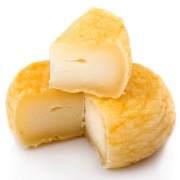
‘Cheese will generally appear as a pre-meal nibble on traditional restaurant tables, sliced or cubed’
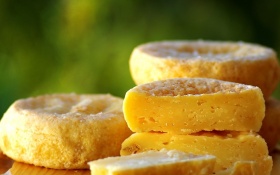
PORTUGUESE CHEESES are mostly ewe (ovelha) and goat (cabra) or a mix of the two. There are cow’s milk cheeses (vaca) as well as sheep and goat in the north, and especially from the lush pastures of the Azores. Cheesemaking is mostly a cottage industry, and country people still make soft, white, fresh cheese (queijo fresco) at home, to eat as a pre-meal nibble, or for breakfast. Some of the best cheeses are out of season in the summer months. You will meet cheese at breakfast, fresh as well as ripened (curado), and cheese will generally appear as a pre-meal nibble on traditional restaurant tables, sliced or cubed.
QUEIJO DA SERRA DA ESTRELA (BEIRAS)
This is Portugal’s star cheese – so we’ve put it first and, exceptionally, out of alphabetical order. The pale, gloopy paste inside the soft, smooth, yellow rind has an irresistible, buttery-lactic flavour. Queijo da Serra is a mountain sheep’s cheese, in season from December to April, and made with the milk of particular breeds of sheep, curdled with thistle extract rather than animal rennet. It is usually eaten after four to six weeks’ ripening, spooned out through the sliced-off lid – our children call it ‘lid cheese’. Serra Velho, aged for five months or more, is firmer and stronger in flavour, and more expensive. Some distinctly lesser cheeses are sold as ‘Tipo Serra’, while some are naughtily passed off as the ‘real thing’. These can be very boring, so beware.
AMARELO DA BEIRA BAIXA (BEIRAS)
Semi-soft cheese similar to Castelo Branco (below) but from a wider surrounding area, made of ewe’s milk alone, or mixed with goat, and curdled with animal rennet. The matured Velho is darker, stronger, firmer.
AZEITÃO (TERRAS DO SADO)
A fine ewe’s milk cheese, based on Queijo da Serra, made for nearly 200 years in the Arrábida hills of the Setúbal Peninsula.
BEIRA BAIXA (Queijos da) (BEIRAS)
Global DOP covering three cheeses with their own sub-DOPs in the south-east of the Beiras: Queijo de Castelo Branco, Queijo Amarelo da Beira Baixa and Queijo Picante da Beira Baixa.
CABRA TRANSMONTANO (TRÁS-OS-MONTES AND DOURO)
Hard goat’s cheese made with animal rennet.
CASTELO BRANCO (BEIRAS)
Serra-like ewe’s milk cheese from Castelo Branco in south-east Beiras, semi-soft, whitish-yellow and smooth. The 90-day-matured Velho version is darker and stronger flavoured. Thistle-curdled.
ÉVORA (ALENTEJO)
Historic little pale yellow cheeses from a large area of central Alentejo. They are salty, semi-hard and crumbly, made from ewe’s milk occasionally mixed with goat. Harder, mature, stronger versions are aged for up to a year. Curdled with thistle extract.
MESTIÇO DE TOLOSA (ALENTEJO)
A small, semi-soft cured cheese from sheep and goats in the northern Alentejo; same areas as Nisa. It is thistle-curdled, its yellowy-orange paste sometimes unctuous, and pleasantly sharp. The rind is wrinkled because rather than being made with salty curd, it is salted from the outside.
NISA (ALENTEJO)
Whitish-yellow, cured, semi-hard pure sheep’s cheese from the northern Alentejo, from a large area surrounding Nisa and Portalegre. Thistle-curdled.
PICANTE DA BEIRA BAIXA (BEIRAS)
From the same large demarcated area around Castelo Branco as the Queijo Amarelo, a smooth, hard or semi-hard cheese, sharply salty, with a wrinkly, greyish rind. Made with goat’s or ewe’s milk, it can be powerful when aged.
PICO (AZORES)
A historic cured cow’s milk cheese from the Island of Pico. Rounded and shallow, with a soft, pale paste, creamy and piquant.
RABAÇAL (BEIRAS)
Small but chubby squashed white balls of cheese from south of Coimbra, gentle and semi-hard; or ripened, firm and stronger flavoured. Legally, it has to be 20-25% goat, 75-80% ewe.
SALOIO
A mild, firm cheese made in the south of the Lisboa VR area, formerly only from ewe’s milk, but now more often from a mix of sheep, goat and cow. Small and cylindrical, it’s fresh and white and often cubed or sliced as a pre- prandial nibble. Saloio means ‘country bumpkin’.
SÃO JORGE (AZORES)
Made from cow’s milk from the island of the same name, in big truckles. Firm, pale yellow, like a soft Cheddar, and indeed introduced long ago by the English.
SERPA (ALENTEJO)
Excellent, mild, Serra-type cheese from the southern third of the Alentejo, lusciously buttery. Ewe’s milk only, and curdled with thistle extract. Serpa Velho with extra ageing is very strong and hard. They can be small or quite large.
TERRINCHO (TRÁS-OS-MONTES AND DOURO)
Squat, paprika-coated, firm, pale yellow cheese made from ewe’s milk in Trás-os-Montes. Smooth and rich.
RICOTTA – Requeijão
Not strictly a cheese, soft, fresh, white requeijão is made from the whey of ewe’s milk, heated until the proteins coagulate. There are DOP versions: Requeijão da Serra da Estrela and Requeijão da Beira Baixa. It is delicious eaten for breakfast, topped with sugar and cinnamon; on bread with quince paste (marmelada), pumpkin jam (doce de abóbora) or honey; as a dessert with caramelised pumpkin, or pumpkin jam; or it might come in restaurants as a pre-meal nibble, to spread on bread. It is also used a lot in cheesecakes and cheese tarts (queijadas).
This is an extract from The Wine & Food Lover’s Guide to Portugal, published by Inn House Publishing. Reproduced with kind permission of the authors.
Look out for The Wine & Food Lover's Guide to Porto & Gaia, due to be published before Christmas 2014