



Taylor’s Port
From Theory into Practice
As Portugal’s premium export, a Port Wine cellar had to be the first port of call for us when visiting Porto


‘The treading of grapes dates back over 2000 years to Roman times and still remains the best method’
WALKING INTO THE Taylor’s Port Cellars in Porto, the sweet smell of fermenting grapes is overwhelming. These cellars have been working in virtually the same manner now for over 300 years, since their foundation in 1692. The Port Wine company, one of the oldest Port houses, has quite remarkably remained independent and family-managed and now combines the very best of tradition with state of the art technology. Today it is run by descendants of the Yeatmans and Fladgates, both families having been partners in the firm since the 1830s.
Deputy Managing Director, Luís Sequiera walked us through the cellars, explaining what makes Taylor’s Port Wines so unique. Their vineyards are 150km away in the Douro valley, protected from the sea by the Marão mountains, and thus in a microclimate with a higher average temperature and lower average rainfall than by the Atlantic coast. Because of the sheer rocky valleys, the vineyards have been bulldozed into manmade terraces, cut into the hillsides. These narrow terraces, a combination of work of Mother Nature and man, are now classified as a UNESCO World Heritage site. The Douro was also the first DOP to be created in the world.
The vines, once planted, burrow down more than 20 metres to find water, absorbing the very best from the soil into the grapes. Everything is harvested by hand. Machines would not be able to manage the geography. This year, unfortunately, the heavy rain has meant that many grapes have been lost. Once picked, open baskets of around 30kg are brought straight to the winery where they are trodden. The treading of grapes dates back over 2000 years to Roman times and still remains the best method. For the Vintage Ports, this is still the way things are done. For the other Ports, Taylor’s now boasts a brand new technology, which replicates this manual process.
After the treading, a process of fortification takes place, during which the yeasts react with the grapes’ sugars to form alcohol. This process is accompanied by the addition of brandy, which marries with the wine to create the subtle and complex flavours of the Port.
There is no difference in the Taylor’s cellars today from 200 years ago. The soil absorbs the humidity as the wines evaporate. On Fridays, the soil is heavily watered to help sustain the process over the weekend. The thick walls and absence of natural light mean that the temperature inside remains more or less constant throughout the year. This is fundamental for the ageing process of the Ports.
The Ruby Ports – Late Bottled Vintage, LBV, for example – are fortified in enormous oak barrels, containing 20,000 litres each. The maturation process takes place via reduction and the resulting Ports have a vivid red colouring, like the precious stone after which they are named. LBV offers an alternative to Vintage Port for less formal moments. It is blended from a selection of the best wines from a single year and matured in the cask for around five years. Because it is already well oxidised and fortified, this wine travels well. It is ready to drink on bottling and, served at room temperature (16-18C), it makes an excellent dessert wine, very good for pairing with chocolate and blue cheese.
The Tawny Ports are fortified in much smaller casks, on average holding 600 litres each. The wine is in close contact with the wood and the ageing process is faster, with maturation via oxidation. The 10 Year Tawny Port is blended from a selection of different wines, whose overall average age is 10 years. This balances the best of youth and maturity. The task of blending is carried out by the company’s Master Blender – a vocation for which many years of training and an exceptional sense of smell are required. The last Master Blender was with Taylor’s for over 50 years. Tawny Ports have a browner, more caramel-like colouring. They are concentrated in sugar and often served slightly chilled. Aged Tawnies are the most versatile of Ports.
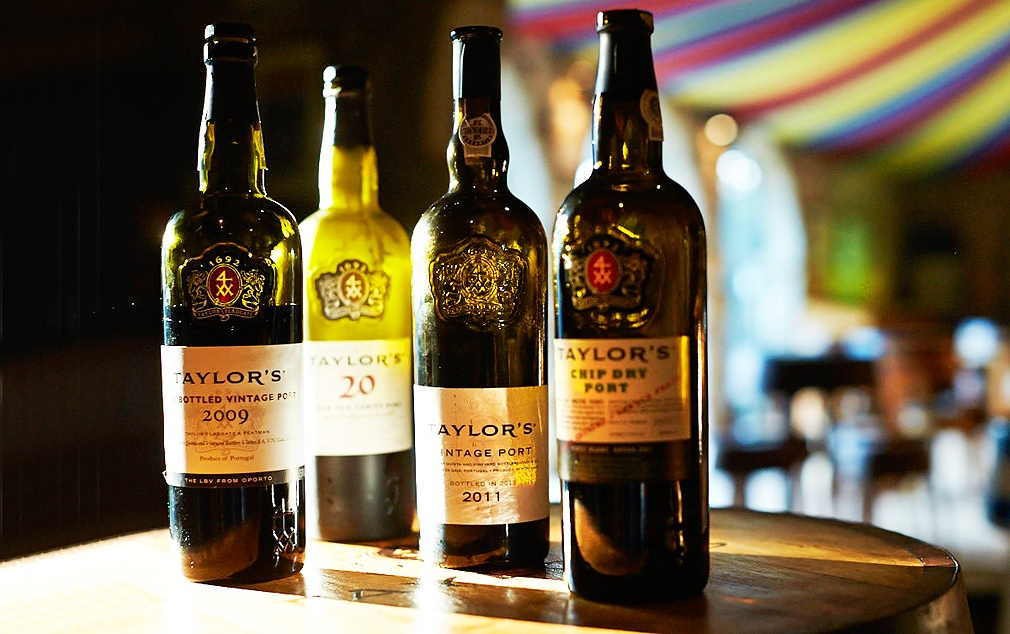
Other Ports worth mentioning are the Vintages, which are the premium wines, always made with the best wines from one single year and bottled two years after harvesting. These are the only Port Wines with the potential to age in the bottle and improve over the years. White Ports, including the Chip Dry Port, offer a crisp, dry aperitif and can also be mixed with tonic water to create a cocktail. These wines were first created in 1934 when the Spanish Civil War prevented Spanish wines and Sherries from being exported to the UK. Even today, this is their only destination.
With thanks also to Catia Silva for the tasting.



